 Junior Vocab
Once upon a time there was a boy named Rupert, the sharpest and most prudent lad in his village, and indeed in any of those to be found for twenty leagues around. One night he was with a group of boys of his own age, who, gathered round the fire, were listening with amazement to a veteran soldier, covered with scars, which had gained him the modest stripes of a sergeant pensioner, and who was telling the story of his adventures. The narrator was at the most interesting point of his tale. “The great City of Fortune,” he said, “is situated on the summit of a very high mountain, so steep that only very few have succeeded in reaching the top. There gold circulates in such abundance that the inhabitants do not know what to do with the precious metal.
Houses are built of it, the walls of the fortress are of solid silver, and the cannons which defend it are enormous pierced diamonds. The streets are paved with duros, always new, because as soon as they begin to lose their brilliance they are replaced by others just minted. “You ought to see how clean it is! What little dirt there is consists of pure gold dust, which the dust carts collect and throw in large baskets into the drains. The pebbles against which we continually stumble are brilliants as large as nuts, despised because of the extraordinary abundance with which the soil supplies them.
In a word, whoever lives there may look upon the most powerful of the earth as beggars. The worst of it is that the path which leads there is rough and difficult, and most people fall by the way without having been able to reach the city of gold.” Rupert did not let the soldier’s words go in at one ear and out at the other; so, as soon as he found a chance to be alone with him, he asked: “Do you know the way to this enchanted city?” “I should rather think so, my son; but I do not advise you to attempt the journey.” “Why?”
“The way is long and rocky. I turned back the very first day, frightened by the difficulties that must be overcome. But in any case, if you are determined to go, I must give you this warning. To reach Fortune there are two paths: a very broad one, full of stones and crags; if you choose that way, the sharp points of the pebbles will tear your feet to pieces and you will be crushed by fatigue. A thousand terrible obstacles will rise up against you; you will have to fight cruel enemies, and if at last you manage to conquer them all, you will arrive at Fortune already old and worn out, when riches will be useless to you.
The other path is level and short, but…” “Enough! Say no more; show it to me at once, and I will see to the rest.” “All right, all right! I will show it to you, and God grant that your refusal to hear me to the end may not bring you suffering.” And the little rogue, without saying good-bye to his parents or his brother, started off in the direction the old soldier had pointed out to him. He went on and on, happier than a sand-boy, thinking of the riches that awaited him and which he already believed he could almost touch with his hand.
At the end of two days he reached the bank of a wide river. On it was a boat, and in the boat a negro of colossal stature. Our lad went up to the boatman and asked him: “Good man, is this the way to Fortune?” “Yes, little boy, but you must cross the river.” “Very well, then take me across.” “Do you know how much it costs?” “No.”
“Fifty duros.” “But do I look as if I had them, or had even seen them in my life? Be kind and take me over for nothing.” “This river, my little friend, is never crossed gratis. It is the first step towards Fortune, and it must be paid for in some way. If you have no money, it does not matter; let me cut off a little piece of your heart. Perhaps it will hurt you a bit at first, but afterwards you will feel as if you were whole.”
Rupert allowed the negro to open his chest and take out a piece of his heart. When he reached the other side he gave a sigh of satisfaction. The first step was taken, and he already saw the beautiful City of Fortune, whose shining walls sent out lovely reflections. But he noticed that he was far less eager to reach the city of gold and felt a strange emptiness in his chest. Nevertheless, he went on his way; but he had not gone a hundred steps when a new difficulty rose up to bar his passage.
The road ran between two inaccessible mountains, and the entrance to the defile was guarded by another keeper, as black as the boatman. “Where are you going, boy?” he asked our lad. “To the City of Fortune.” “Quite right, this is the way; but you must pay for the passage. The payment is a little piece of heart.” Without hesitating, Rupert opened his chest and left a handful of fibres of that organ of life in the hands of the terrible gate-keeper.
And he went on and on towards the city, which each time appeared nearer and more beautiful to his eyes. But each time he felt less desire to arrive. Still his trials were not over. The path soon narrowed and sank into a dreadful ravine; merely thinking of crossing it seemed beyond his strength. Rupert believed his hopes shattered, and sat down, discouraged, on a stone.
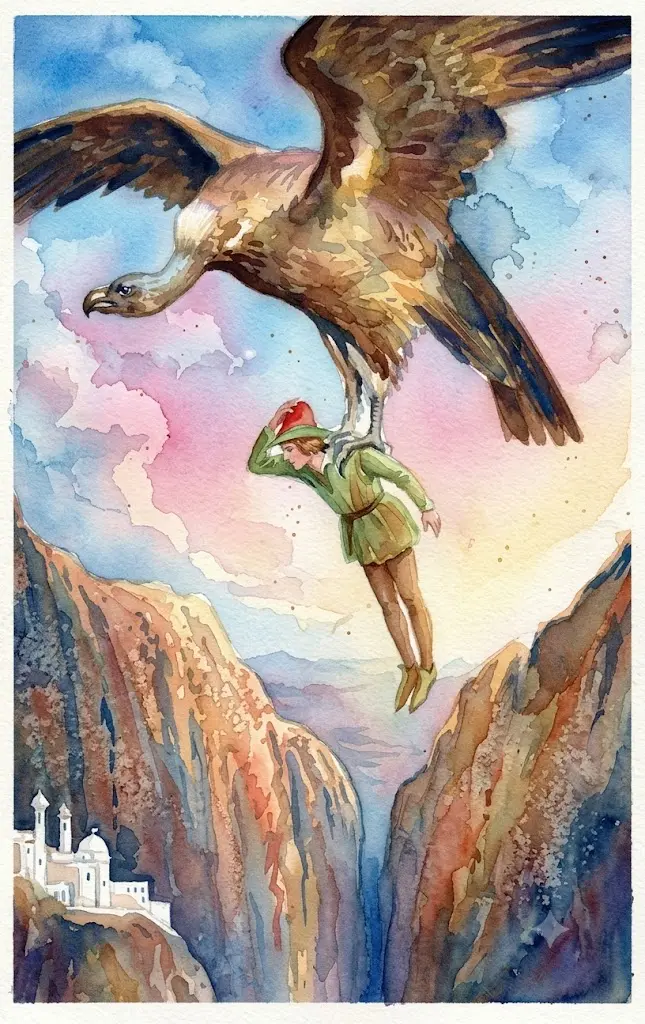
At that moment a vulture of great size came down from the top of a mountain and, drawing near him, said: “Do you wish to go across? Well then, give me a piece of your heart.” “Take it, and carry me over,” said Rupert, in despair. The vulture thrust its beak into Rupert’s chest and took out a good piece of heart. At once it seized our lad with its claws and bore him to the other side of the abyss.
Now he was at the very gates of Fortune. He could already count the number of towers rising above the high walls, and he took his happiness for certain—if happiness consists in money. At the gate they stopped him. There, heart was contraband, and so they removed what remained of his and put inside him a pretty one made of steel, hard as a diamond. Only one little fibre escaped their search and slipped unnoticed behind the metal heart.
“At last I am inside,” said Rupert to himself; but, strangely enough, the city of gold caused him neither wonder nor joy. “What do I want riches for?” he exclaimed, “if I have lost my heart and with it my illusions?” And he walked through the city, looking with great disdain at those riches within reach of his hand which had so strongly tempted his ambition before. That dazzling brilliance began to trouble him. “Here,” he said to himself, “there seems to be nothing but gold.
Cursed metal, which has cost me my heart. Goodness me! Who will give me back my little heart?” He looked for friends, but could not find any, because those people had hearts of steel, and Rupert felt that the little fibre that remained of his own made him suffer atrociously. Without friends or affection in that city of gold, Rupert remembered his parents and his brother and bitterly lamented his fate. Then he decided to return to the little white house in his own village and to live there as God had ordered.
As he left the city he felt a strange joy. But that wretched steel heart tormented him horribly; only the little fibre that remained of his own beat for joy in his breast. He took the first path he found, and now met with no difficulties. It seemed as if wings had grown on his feet. He went downhill and so walked very quickly.
When he reached his village he was as poor as before, and besides, that cold, hard heart hardly let him breathe. It beat with the regularity of a clock, tic-tac, tic-tac! His brother was the first to come out and meet him, full of joy. He embraced him, kissed him, and accompanied him home, transported with gladness. But the steel heart did not allow Rupert to share that joy.
Tears did not rise to his eyes, and his chest felt as if a hand were pressing on it. His old father strained him to his bosom, but not even he managed to move that hard heart. Rupert felt an extraordinary anguish. But his mother came running, out of breath, towards her son, and embraced him weeping, and her tears fell on Rupert’s heart.
Then, oh, the power of a mother’s love! That steel heart quickened its beats and, unable to resist any longer, sprang out, just as the broken spring of a watch flies out. The little fibre had already become a new heart and Rupert a happy man. And when they spoke to him of riches he said: “God will give them if he deem it right, but don’t seek them by short cuts at the expense of your heart and illusions.”